
DIPI Signal Alert: Decoding CryptoQuant’s Warning of Potential Market Washout and How to Manage Extreme Risk | MEXC Analysis
07.07.2026 21:34
The Deflationary Force: Analyzing Tether’s Massive USDT Burn and Its Impact on Crypto Scarcity | MEXC Analysis
08.07.2026 00:11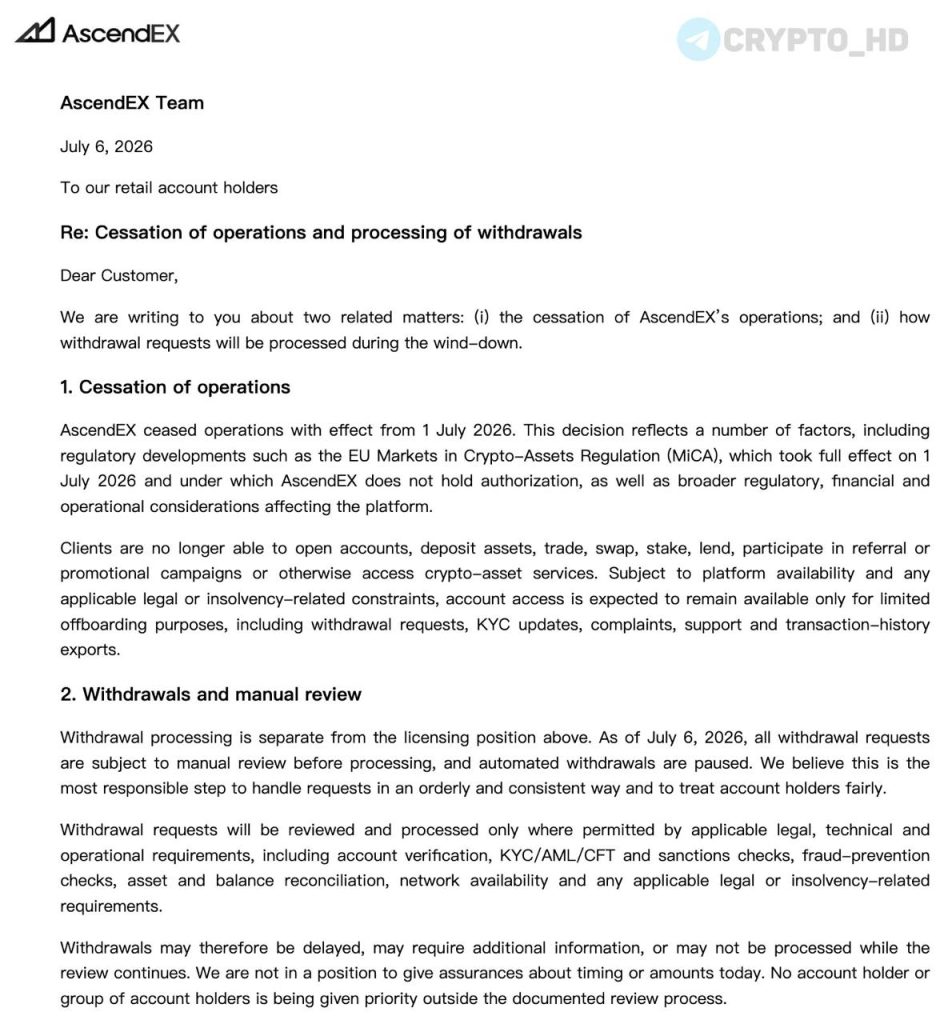
The Red Flags of Centralization: Why Exchange Failures and Regulatory Pressure Signal a Market Shift | MEXC Analysis
The cryptocurrency market has always been characterized by rapid innovation and decentralized ideals. However, recent events—such as the reported operational shutdown of exchanges like AscendEX due to liquidity issues and regulatory pressures—serve as stark reminders that even this seemingly boundless industry is subject to traditional financial forces: regulation, solvency, and capital control. This analysis decodes what these exchange failures mean for retail investors and why understanding global compliance standards (like MiCA) is now more critical than ever.
📉 The Anatomy of an Exchange Collapse: Liquidity vs. Regulation
When a major exchange halts services or issues warnings about “insolvency procedures,” it’s rarely due to a single factor. It’s usually a toxic mix of poor internal liquidity management and external regulatory headwinds. In the case of AscendEX, reports point directly to operational failures and an inability to meet stringent European standards like MiCA (Markets in Crypto-Assets). This is a critical lesson for every crypto participant: **the exchange itself is not the asset.** Your security lies in your own understanding of risk.
The shift from automated withdrawals to manual, slow processes is a classic warning sign. It indicates that the exchange’s internal financial plumbing is compromised, forcing them into a defensive, resource-intensive mode. This highlights the absolute necessity for users to maintain vigilance and always keep their assets secured in self-custody wallets when possible.
🇪🇺 The Global Regulatory Wave: MiCA as the New Standard
The primary driver behind many of these failures is regulatory pressure. The European Union’s Markets in Crypto-Assets (MiCA) framework represents a monumental attempt to bring clarity and consumer protection to the entire digital asset space. While this regulation is essential for legitimizing crypto—allowing institutions like those tracked by The SEC’s Grand Strategy: How the US Plans to Become the Global Crypto Capital—it also creates a massive compliance barrier for smaller, less established exchanges.
For an exchange to survive and thrive in this new environment, it must prove its solvency, adherence to Anti-Money Laundering (AML) protocols, and robust consumer protection measures. This is why understanding The Rise of Crypto Compliance: Why AML Checks Are Non-Negotiable for Modern Digital Assets is paramount.
🛡️ Protecting Yourself from Exchange Risk (Self-Custody First)
The most important takeaway from any exchange failure report is the golden rule of crypto security: **Never leave your eggs in one basket.** The only way to guarantee control over your assets and bypass potential exchange insolvency issues is through self-custody wallets. While exchanges offer convenience, they introduce a single point of failure that can be exploited by poor management or regulatory action.
Furthermore, the market’s overall health remains anchored by foundational institutional interest. The continuous accumulation of BTC and ETH by major players like BlackRock signals deep, long-term conviction in the asset class, which helps absorb the shocks caused by individual exchange failures: 🐋 Whale Activity Alert: Decoding Institutional Long Positions and What It Signals for BTC & ETH.
📈 The Structural Pillars of Crypto Value
Despite the risks posed by individual exchanges, the underlying structural value of major cryptocurrencies remains robust. This strength is visible in:
- Institutional Demand: Massive capital inflows from traditional finance (TradFi) validate crypto as a legitimate asset class.
- Structural Scarcity: Deflationary mechanisms, such as the burning of stablecoins on Ethereum, create an invisible floor that supports core assets. For more details, read The Deflationary Force: Analyzing Tether’s Massive USDT Burn…
- Technical Support: Core assets like ETH maintain critical technical support levels, acting as a safety net during periods of market panic. Check out ETH Key Support & Liquidity Analysis: Decoding the $1650 Zone for Longs.
⚠️ Conclusion and Risk Management
Exchange failures are not just news stories; they are critical educational moments. They serve as a stark warning to all participants about the risks of centralization, poor governance, and regulatory non-compliance. The best defense against such systemic risk is rigorous self-education and disciplined capital management.
To protect your portfolio from market hype cycles and unexpected crashes, always implement robust DIPI Signal Alert: Decoding CryptoQuant’s Warning of Potential Market Washout and How to Manage Extreme Risk.
🚀 Trade with Confidence on MEXC
To participate in the global crypto market with world-class security, liquidity, and advanced tools, access a reputable and compliant exchange like MEXC:
Disclaimer: This article is for educational purposes only and does not constitute financial advice. Always conduct your own research (DYOR).