
🐋 Whale Activity Alert: Decoding Institutional Long Positions and What It Signals for BTC & ETH | MEXC Analysis
07.07.2026 21:05
The Red Flags of Centralization: Why Exchange Failures and Regulatory Pressure Signal a Market Shift | MEXC Analysis
07.07.2026 23:17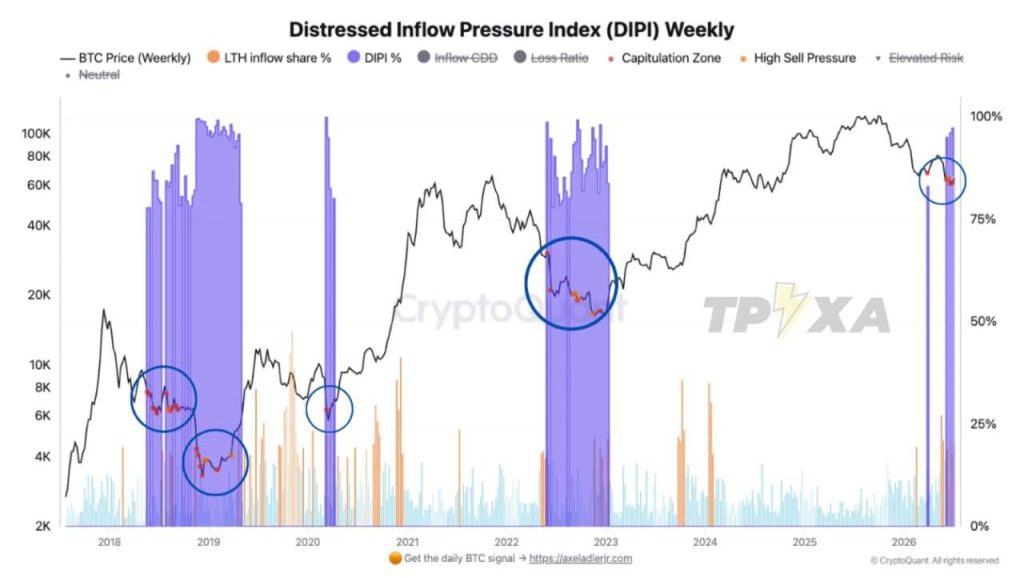
📉 DIPI Signal Alert: Decoding CryptoQuant’s Warning of Potential Market Washout and How to Manage Extreme Risk
The cryptocurrency market is perpetually characterized by extreme swings, swinging between euphoric greed and deep capitulation. Recently, analysts at CryptoQuant flagged a critical on-chain metric called DIPI (Bitcoin Stress Inflows). This indicator tracks the influx of “stressed” BTC—coins transferred to exchanges that are often liquidated or moved due to financial distress. Historically, major spikes in DIPI have preceded massive market washouts and significant corrections, echoing events seen during 2018 and 2022. While this signal is not a guarantee of a crash, it serves as an urgent, high-priority warning for every trader: the current market environment demands extreme caution, disciplined risk management, and a deep focus on structural fundamentals rather than short-term hype.
Understanding the DIPI Signal: What Does Stress Inflow Mean?
DIPI is a powerful tool that measures stress within the Bitcoin ecosystem. When this metric spikes, it suggests that large amounts of BTC are moving onto centralized exchanges (CEXs) not because they are being sold for profit, but often because their holders need immediate liquidity—a sign of distress selling.
- The Warning: A sustained spike in DIPI can signal a potential wave of panic selling as distressed capital floods the market, contributing to downward pressure and market washout.
- The Counterpoint (Institutional View): Conversely, some advanced analysts view these inflows not just as liquidation, but as preparatory accumulation by sophisticated institutional players who are staging funds for large-scale purchases before deploying them into a major move.
Regardless of which narrative proves true, the signal itself is an undeniable warning: the market’s current momentum may be highly fragile and susceptible to sudden reversals. For those interested in understanding how major financial institutions view structural strength and accumulation efforts despite these warnings, review Whale Activity Alert: Decoding Institutional Long Positions and What It Signals for BTC & ETH.
The Pillars of Resilience vs. Speculation
In a market prone to such dramatic swings, the most valuable information is not the signal itself, but the structural pillars that provide resilience against panic selling. These pillars are what differentiate speculative altcoins from foundational assets like Bitcoin and Ethereum.
1. Institutional Conviction (The Macro View)
The long-term accumulation efforts by major financial players—like BlackRock’s continued buying of BTC and ETH—demonstrate an unwavering, multi-year belief in the asset class’s role as a global store of value. This conviction acts as a powerful counterweight against temporary distress signals. For a detailed look at how institutional capital is driving this structural strength, review BlackRock’s Massive BTC & ETH Accumulation Signals Institutional Conviction.
2. Regulatory Maturation (The Governance View)
The global push for regulatory clarity, exemplified by the US government’s plans to establish itself as a crypto capital hub, is fundamentally de-risking the market. As governments formalize digital asset services and focus on compliance, they legitimize the entire industry structure. Understanding this macro shift is critical: The Rise of Crypto Compliance: Why AML Checks Are Non-Negotiable for Modern Digital Assets.
3. Technical Support (The Technical View)
Furthermore, foundational assets like Ethereum (ETH) maintain crucial technical support levels—such as the $1650 zone—that act as critical safety nets during market stress. Understanding these liquidity zones is paramount for defining entry and exit points when volatility spikes: ETH Key Support & Liquidity Analysis: Decoding the $1650 Zone for Longs.
The Ultimate Lesson: Risk Management is Non-Negotiable
A signal like DIPI is a warning bell, not an instruction manual. The most valuable skill a trader can possess is not signal detection, but risk management. A market washout warning should trigger caution, not panic. This means adhering to strict rules: defining your maximum acceptable loss before entering any trade and never letting FOMO or FOGO dictate your actions. For a comprehensive guide on surviving these volatile cycles, read The Danger of Hype Cycles: Analyzing the TON Ecosystem Token Crash and Crypto Risk Management.
Current Market Snapshot & Strategic Takeaways
As of today, Bitcoin is trading at 64035.57 USDT, showing resilience but remaining highly sensitive to on-chain metrics and macro news. The key takeaway is that while stress signals are real, the underlying value proposition—supported by institutional demand and regulatory maturation—remains robust.
For Traders: Actionable Steps
- Treat Signals as Warnings: View DIPI spikes not as predictions of doom, but as reminders to tighten your risk parameters.
- Focus on Fundamentals: Base your long-term thesis on structural pillars (institutional demand, regulatory clarity) rather than short-term price action.
- Prioritize Security: Always ensure you are trading through a world-class platform that provides unparalleled liquidity and advanced tools:
🔗 Trade with Confidence on MEXC: MEXC Referral Link
*Source Material:* Synthesis of CryptoQuant’s DIPI metric, cross-referenced with historical market data and institutional flow reports.