

Rising Open Interest in Cryptocurrencies: A Positive Trend for Investors and Traders
18.07.2026 10:51
The Implications of China’s Ban on Romantic AI Interactions for Children
18.07.2026 11:03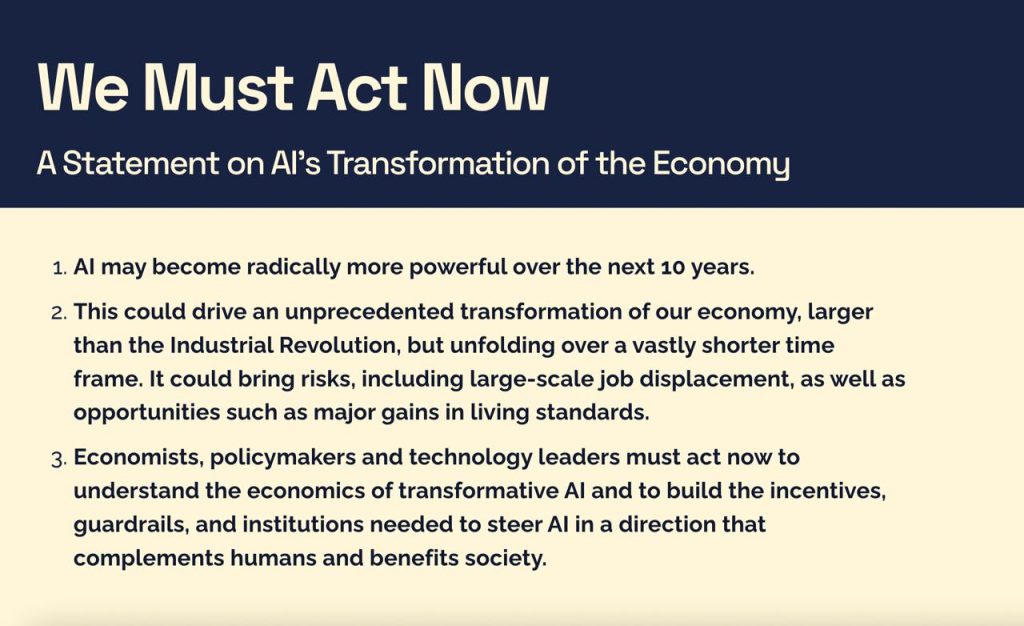
The Economic Implications of Transformative AI: Insights from Leading Economists
Background and Context
On July 12, 2026, a significant event unfolded as 200 economists and business leaders, including 15 Nobel laureates, publicly addressed the urgent need to understand the economics of transformative artificial intelligence (AI). This open letter emphasized the necessity for immediate action to study AI’s far-reaching economic implications and highlighted the potential for unprecedented changes within our economy.
Historically, technological advancements have reshaped economies, with the Industrial Revolution serving as a prime example. However, the letter warns that the upcoming transformation driven by AI could surpass these changes in both scale and speed. Unlike previous revolutions that occurred over decades, the AI revolution is projected to unfold within a matter of years, fundamentally altering job markets, economic structures, and societal norms.
Key Data and Metrics
According to recent studies, AI could lead to the automation of up to 30% of jobs by 2030, affecting millions globally. This shift is not only about job displacement; it encompasses a broader economic transformation that could enhance productivity and efficiency across various sectors. For instance, McKinsey & Company estimates that AI could contribute an additional $13 trillion to the global economy by 2030, signifying a substantial opportunity for growth.
Moreover, the increased reliance on AI technologies is expected to drive down costs and improve service delivery in industries such as healthcare, finance, and manufacturing. However, the transition to an AI-centric economy necessitates careful consideration of the accompanying risks, particularly the potential for widespread job loss and increasing inequality.
Market Analysis
The current landscape of AI investment reflects a growing recognition of its potential. Venture capital funding for AI startups reached an all-time high of $75 billion in 2025, indicating strong market confidence in the technology’s future. This influx of capital not only fosters innovation but also pushes companies to integrate AI into their operations, further accelerating the economic shift.
As discussed in our analysis of rising open interest in cryptocurrencies, the intersection of AI and blockchain technology is particularly noteworthy. The implementation of AI can enhance trading algorithms, improve market predictions, and optimize asset management, creating new avenues for investors.
Expert Perspectives
Prominent economists stress that understanding AI’s economic impact is paramount for policymakers. They advocate for the establishment of protective measures and incentives that guide AI development towards enhancing human capabilities rather than merely displacing jobs. As highlighted in the letter, collaboration among economists, technologists, and policymakers is essential to navigate this transformative period effectively.
Economists also caution that without proactive measures, the rapid adoption of AI could exacerbate existing inequalities. Those with access to AI technology and skills will likely thrive, while others may be left behind. The need for educational reforms and reskilling initiatives is critical to equip the workforce for the future.
Risks and Opportunities
The dual nature of AI presents both risks and opportunities. On one hand, the displacement of jobs poses a significant challenge, particularly for low-skilled workers. The potential for economic disruption is enormous, with entire industries facing obsolescence. On the other hand, the growth potential is equally vast. AI can drive innovation, create new job categories, and improve overall productivity.
As indicated in our analysis of market sentiment, the volatility in current markets reflects apprehension towards rapid technological changes. Investors must remain agile and informed to capitalize on emerging opportunities while mitigating risks associated with AI adoption.
Future Outlook
The future of the economy in the wake of transformative AI is both promising and uncertain. As AI technologies continue to evolve, their integration into everyday life will deepen, influencing consumer behavior and economic dynamics. The emphasis on innovation and efficiency will likely reshape market structures and competitive landscapes.
To prepare for this transformation, businesses must adopt a forward-thinking approach. This includes investing in AI research and development and forming strategic partnerships that leverage AI’s capabilities. The changing landscape will also require companies to adapt their workforce strategies, focusing on continuous learning and development to stay relevant.
Conclusion
The open letter from economists and business leaders serves as a clarion call for immediate action in understanding the economics of transformative AI. The potential benefits are immense, but they come with significant challenges that must be addressed. As we move towards an AI-driven economy, the collaboration between policymakers, technologists, and economists will be crucial in harnessing AI’s potential while safeguarding against its risks.
Investors and traders should closely monitor these developments, as the economic landscape will evolve rapidly. Strategic investments in AI-centric companies and adaptation to new market realities will be paramount for success in this transformative era. For those looking to engage with the evolving crypto landscape, consider exploring opportunities on platforms like MEXC.