
China’s Rocket Breakthrough: Cable Recovery System Challenges SpaceX in Reusable Spaceflight
10.07.2026 17:04The AI Revolution and the Future of Work: How Humanoid Robotics is Reshaping Industries
11.07.2026 01:25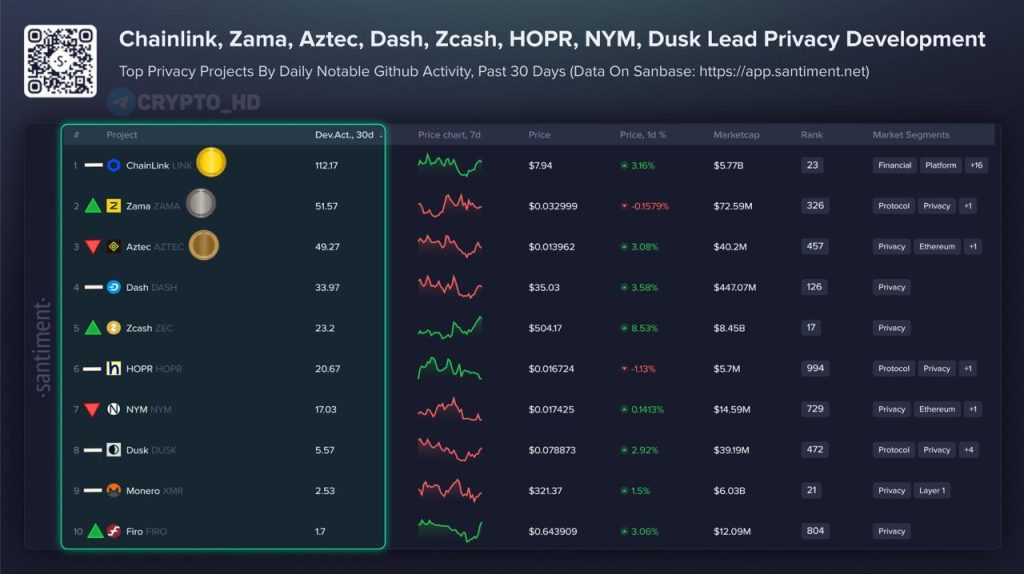
The Rise of Privacy Coins: Analyzing Developer Activity and the Future of Anonymity in Web3
In the rapidly evolving landscape of decentralized finance (DeFi), one sector consistently demands attention from both innovators and regulators: privacy. As blockchain technology becomes more integrated into global commerce, the need for truly anonymous transactions has never been higher. A recent analysis by Santiment highlighted the Top 10 crypto projects focused on privacy, ranking them based on developer activity over the last 30 days. This list—featuring industry giants like Chainlink (LINK), Zama (ZAMA), and Aztec (AZTEC)—serves as a crucial barometer for where development focus is shifting within the Web3 ecosystem.
What Does Developer Activity Signal in Privacy Coins?
The ranking itself is highly informative. It doesn’t just list coins; it maps the current intellectual capital flowing into anonymity-preserving technologies. High developer activity, particularly around projects like Zcash (ZEC) and Monero (XMR), signals that these protocols are not static relics but rather living, evolving pieces of infrastructure undergoing constant scrutiny and improvement. For investors, this is a positive sign: the technology is being actively maintained against increasing threats.
The core value proposition of privacy coins remains unmatched by transparent chains. They offer a necessary counterpoint to the growing surveillance capabilities inherent in centralized finance (TradFi). This structural need for anonymity ensures that these protocols will remain relevant, regardless of short-term market hype cycles.
Key Players and Sector Trends
The top spots are dominated by established players with deep cryptographic roots. Chainlink (LINK)‘s inclusion is particularly noteworthy, as it represents the convergence of decentralized oracles—a critical piece of infrastructure for almost all smart contract applications—with privacy concerns. This suggests that even foundational services must incorporate anonymity features to meet enterprise-level demands.
Furthermore, the list highlights a diversification of focus: while some coins like Zcash (ZEC) continue to lead with their battle-tested shielded pools, others like Aztec (AZTEC) and Dash (DASH) are carving out niches by integrating privacy into specific use cases, such as decentralized identity or cross-chain communication. This fragmentation is healthy for the ecosystem, indicating multiple solutions addressing different levels of required anonymity.
The Structural Importance of Privacy in Web3
The need for robust privacy mechanisms is a fundamental structural requirement for mass adoption. As more real-world assets (RWAs) and institutional capital flow onto blockchains, the risk of deanonymization increases exponentially. Protocols that can guarantee user privacy—like those listed by Santiment—are best positioned to handle this influx of sensitive data.
This concept is directly related to how major financial institutions are rethinking digital assets. For instance, understanding JPMorgan’s warning on private blockchains and structural threats provides a macro view of why privacy is becoming a mandatory feature for institutional adoption.
Market Context: Bitcoin, Ethereum, and the Need for Safety
While altcoins like ZEC are gaining attention due to their unique features, it is crucial not to lose sight of the market’s foundational pillars. The overall health of the crypto market—driven by Bitcoin (BTC) and Ethereum (ETH)—provides the necessary liquidity and confidence for smaller projects to thrive.
Currently, BTC remains strong, showing resilience with a live price near $63,918.87 USDT, while ETH is maintaining momentum at around $1,788.93 USDT. This stability in the major assets provides a solid base for altcoin speculation.
However, market cycles are cyclical. When analyzing risk and opportunity, it’s vital to understand the broader momentum of the entire Web3 sector. The current “Green Zone” suggests that while altcoins are active, they must be viewed within the context of overall market maturity.
Conclusion: Privacy as a Utility, Not Just a Feature
The Santiment ranking confirms that privacy is not merely a niche feature but a core utility driving development. The continued focus on developer activity in these coins suggests an ongoing arms race between anonymity protocols and surveillance technology—a battle the crypto industry must win for true global adoption.
For investors, this means prioritizing projects with demonstrable technical depth and active development teams. To manage your overall portfolio risk while capitalizing on sector-specific growth, always remember to review the risks associated with memecoins alongside the potential of privacy infrastructure.
🚀 Ready to Trade Securely?
The crypto market is always moving, and staying informed about security upgrades like this gives you a competitive edge. Don’t miss out on the next major trend! Start your journey with confidence by trading on MEXC today: 🚀 Trade on MEXC
Disclaimer: This article is for informational purposes only and does not constitute financial advice. Cryptocurrency investments are highly volatile. Always conduct your own research (DYOR) before making any investment decisions.
**Tags:** PrivacyCoin, Zcash, Chainlink, Web3Security, DeFi
**Categories:** Crypto News, Security & Tech