
North Korean Hack: A Self-Inflicted Wound in Crypto Theft
24.07.2026 21:16
ETF Inflows: A Bullish Trend or a Mere Blip?
25.07.2026 08:23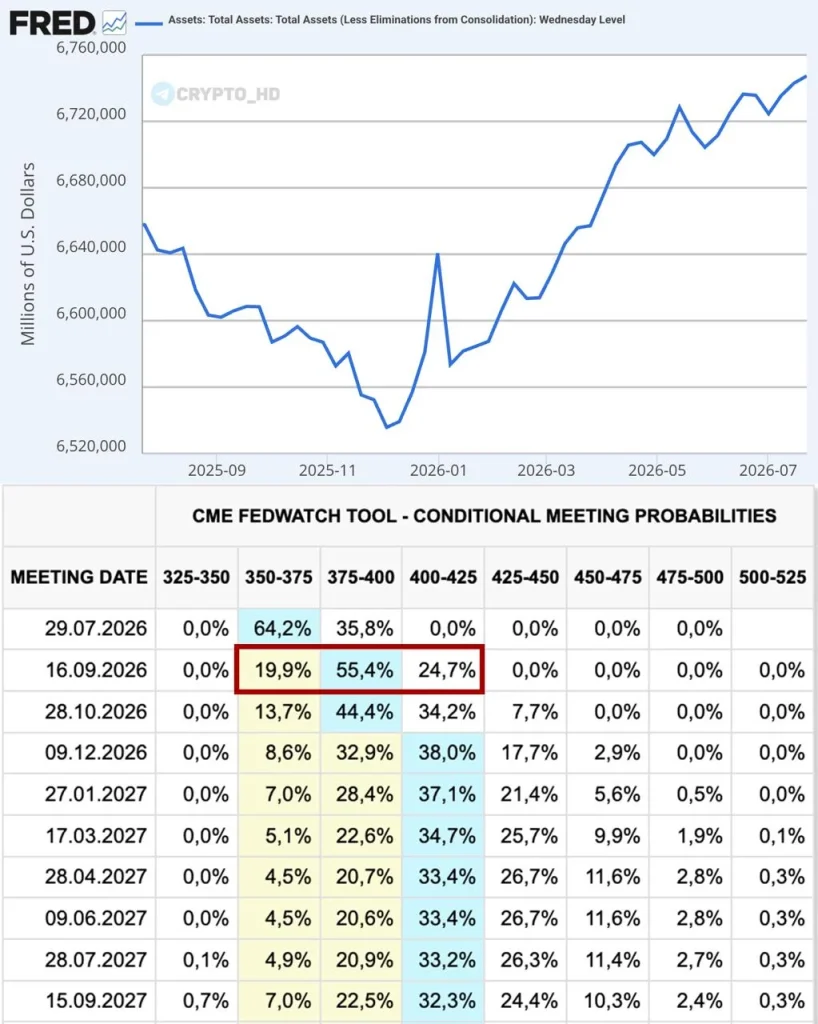
Federal Reserve Balance Rise: Implications for Cryptocurrency Markets
The Fed’s Balance and Market Reactions
The Federal Reserve’s balance sheet has swelled by $4.35 billion in just a week. This development comes as the Fed enters a “quiet period” before its upcoming meeting on July 29. With financial markets ever watchful, the significance of this increase is multifaceted. As noted by John Williams, President of the Federal Reserve Bank of New York, sudden increases in the Fed’s balance can signal changes in monetary policy, subsequently affecting investor sentiment.
Economists are keeping a close eye on interest rates. Most predict that the Fed will maintain the rate between 3.50% and 3.75%. Rising oil prices and persistent inflation are being cited as conditions that virtually rule out a rate cut in 2026. According to a recent assessment of market conditions, macroeconomic pressures continue to test investor resolve, particularly within the cryptocurrency space.
What Experts Are Saying
Reuters reports that most economists expect the Fed to hold rates steady, yet recent developments suggest a growing probability of a rate hike by the end of the year. The possibility of this outcome has pushed uncertainty levels higher. As mentioned by Karen Dynan, an economist at Harvard University, “the increased uncertainty surrounding Federal Reserve decisions inherently increases market volatility, particularly for risk assets like cryptocurrencies.”
The Wall Street Journal also indicates that predictability around Fed’s decisions has dwindled. The chance of a rate increase at the next meeting now stands at roughly one third, suggesting investor caution. In financial terms, as discussed in our analysis of market disruptions, such developments require traders to hedge against unexpected policy shifts.
Perspectives from Major Banks
Barclays anticipates that the Fed will maintain rates unchanged, but warns that energy market volatility could maintain a hawkish stance. This insight aligns with JPMorgan’s expectations that rates will remain constant through 2026, projecting the first shift to be a 25 basis point hike in September 2027. Here, the interplay of interest rates and cryptocurrency trajectory cannot be overstated.
Morgan Stanley posits that the existing rate will hold, attributing this to a slowing inflation rate. They contrast this with market assumptions that at least one rate hike is expected in 2026. The bank’s analysis suggests that tempered inflation due to Federal policies can potentially alleviate pressure on cryptocurrencies, permitting growth in stablecoins and other assets.
The Broader Implications: Oil Prices and Inflation
Rising oil prices, coupled with persistent inflation, are creating a unique economic landscape challenging both traditional and crypto markets. It’s a scenario where inflationary pressures could spook risk-averse investors. According to James Galbraith, a noted economist, “Commodity prices directly affect consumer costs and spending behaviors, which ripple through to equity and digital asset markets.”
The reported oil price surge has reverberated through various asset classes, and cryptocurrencies are no exception. As discussed in our analysis of technological challenges, adaptability remains crucial in navigating the current financial ecosystem.
The Complex Dynamics of Interest Rates
Interest rate decisions are not merely academic. They have tangible effects on liquidity and investment strategies. As rates dictate borrowing costs, they influence individual and institutional behaviors alike. The current standing leaves many to contemplate how prolonged periods of steady rates might affect investments, particularly in volatile markets like cryptocurrencies.
An observation from a recent MEXC analyst report shows how elevated uncertainty can lead to capital flow shifts, reinforcing Bitcoin’s standing as a digital hedge. With liquidity finding alternative routes, such decisions are critical to crypto exchanges and corporate Bitcoin strategies.
Market Expectations and Speculations
The immediate future holds a pause on July 29, followed by an anticipated 25 basis point hike slated for September 16, setting the range to 3.75%-4.00%. For investors, both these dates are pivotal, each representing potential volatility catalysts. Ray Dalio, founder of Bridgewater Associates, emphasizes that “strategic impatience and nimbleness will define winners in such periods of heightened uncertainty.”
Each Fed decision sends ripples throughout global markets, from commodities to crypto assets. Investors are therefore advised to constantly recalibrate their positions. According to a recent report on regulatory shifts, readiness to adapt remains key.
Professional Verdict
Investors should be acutely aware of impending Fed decisions, which could signify broader market shifts. The current economic landscape blends cautious optimism with fiscal realities, especially as risk metrics tilt. This presents a conundrum for crypto investors: adopt a wait-and-see approach or act preemptively based on projected rate hikes?
Those engaging in direct trading or cryptocurrency investment must remain agile, closely following both US monetary policies and global economic indicators. As the financial world stands at a strategic crossroads, it is not only the Fed’s actions that should guide investments but also the subtle cues from emerging market trends.
For those looking to delve deeper into cryptocurrency trades, consider exploring MEXC for opportunities where informed trading meets strategic foresight.
Author: Gloria Cassell