
Apple Faces $1.8 Million Bitcoin Loss Lawsuit: A Hard Look at Responsibilities
26.07.2026 16:31
Upcoming Macroeconomic Events: Beyond the Headlines
26.07.2026 17:06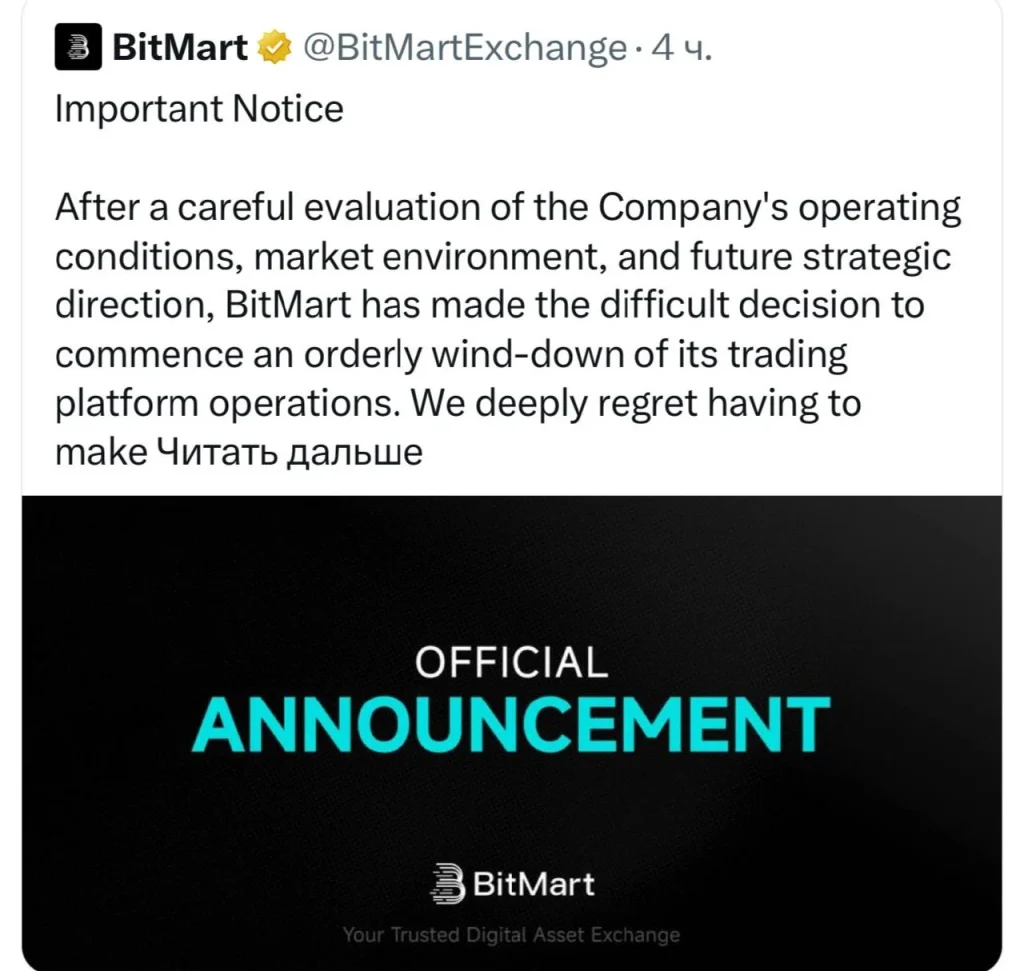
BitMart Closure Raises Concerns Over Crypto Exchange Stability
A Week of Closures: What Happened?
The crypto market faced another shock as BitMart, a well-known cryptocurrency exchange, announced its closure. This comes just days after another exchange ceased operations, marking a turbulent period for digital asset platforms. According to sources familiar with the situation, liquidity issues may have driven this decision, although specific details remain scarce.
BitMart’s shutdown is not an isolated incident. In recent months, the crypto industry has witnessed several exchanges grappling with regulatory challenges and financial strains. This shutdown signifies a deeper issue of sustainability within the sector.
The Impact on Market Confidence
BitMart’s closure could significantly impact trader confidence. With users potentially losing access to their funds, questions about the security and reliability of crypto exchanges become more pronounced. According to Jake Foster, a crypto analyst with Blockchain Insights, “When exchanges like BitMart go offline, it shakes trust across the board.”
The market needs more transparency and regulatory oversight. Without these, potential investors might be deterred from the burgeoning crypto market. This could lead to a contraction similar to what happened after recent scam revelations.
What Industry Leaders Say
Industry leaders have been vocal about the importance of sound financial practices within exchanges. As noted by Michael Saylor, CEO of MicroStrategy, it’s essential for platforms to maintain robust reserves. “Exchanges need to operate transparently, akin to traditional financial institutions,” Saylor mentioned at a recent summit.
The upheaval also mirrors a gap in regulation that some countries are addressing. Europe’s MiCA framework aims to regulate crypto markets more stringently, as detailed in our report on MiCA’s impact. This framework could help stabilize the industry globally.
Exploring Financial Turmoil
Financial instability has long haunted the cryptocurrency exchange sector. For BitMart, the financial strain may have been exacerbated by the recent downturn in crypto prices. Historical data shows exchanges often struggle during bearish phases; BitMart’s case is reminiscent of past closures such as Mt. Gox in 2014.
In addition, competition from decentralized finance (DeFi) platforms offers traders alternative avenues, siphoning off users and liquidity from centralized exchanges. Exchange sustainability might depend on how they adapt to incorporate decentralized elements without compromising security or transparency.
Analyzing BitMart’s Downfall
Reflecting on BitMart’s operational strategies might provide more insights into its downfall. As noted in our previous analysis, aggressive expansion without proper risk management could have played a part. If the exchange over-leveraged on certain asset classes or failed to hedge sufficiently, it may have been vulnerable to the market’s volatility.
This highlights a cautionary tale for other exchanges: financial prudence and strategic risk management should be prioritized over rapid expansion.
The Future of Crypto Exchanges
With BitMart’s exit, the trajectory of centralized exchanges is under scrutiny. Some analysts, like Claire Thompson from FinTech Consulting, argue that “this could be a chance for consolidation, where only the most secure and efficient exchanges survive.” Such a scenario could ultimately benefit traders through more reliable services.
Yet, others see this as a call to innovate. As discussed in our report on tokenized assets, exchanges that integrate cutting-edge technologies while ensuring compliance and security could lead the next wave of industry growth.
Uncertainty and Opportunity
The closure of BitMart and recent instability highlight both the risks and opportunities within crypto trading. Traders must be ever more vigilant and discerning when selecting platforms. Given the current market flux, strengthening due diligence practices is paramount.
The regulatory landscape is evolving. If exchanges can adapt while maintaining user confidence, potential growth could remain significant. But, the lessons from BitMart are clear: robustness and transparency can’t be compromised for growth. According to my professional verdict, this could be a turning point, heralding a more accountable era for crypto exchanges.
Author: Gloria Cassell