
GPT-5.6 Sol Ultra Solves 50-Year Mathematical Mystery (Graph Theory Breakthrough)
13.07.2026 00:17Turkey’s $850M Laundering Bust: What It Means for Global Crypto Regulation and Bitcoin’s Future
13.07.2026 01:46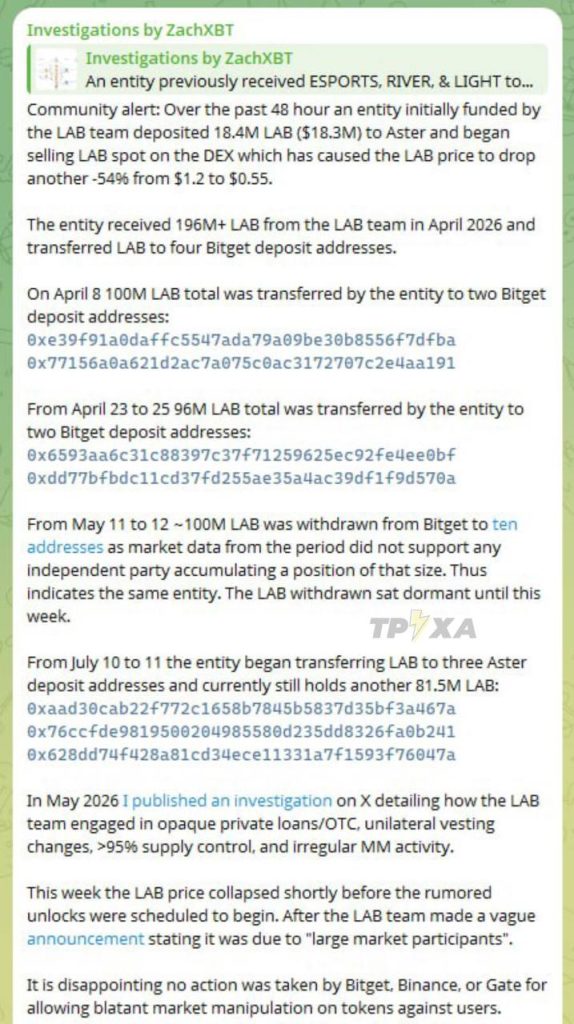
The crypto market is constantly navigating a complex web of innovation, institutional adoption, and—crucially—manipulation. Recent reports detailing alleged supply control fraud involving tokens like LAB, centered around the Bitget exchange, serve as a stark reminder that even in a rapidly maturing industry, systemic risks remain high. The accusations raised by investigators like ZachXBT point to deep-seated issues concerning transparency, market integrity, and the opaque nature of centralized exchanges (CEXs).
The Centralized Exchange Risk Paradox
When major tokens experience massive, unexplained drops—such as the reported 98% decline in LAB—and these events are linked to specific exchanges, it raises fundamental questions about custodial risk and market fairness. The core issue is one of trust: users must trust that an exchange will operate transparently and fairly. When allegations surface regarding “supply control” or collusion, this foundational trust erodes rapidly.
This pattern of alleged manipulation isn’t unique. It echoes historical moments where high-profile hacks or suspicious market movements have triggered panic selling. For instance, the recent analysis of major DeFi security risks highlighted by a $14.2 million heist serves as a chilling reminder that even sophisticated smart contracts are not immune to failure. These incidents force the entire industry to confront its vulnerabilities.
Why Decentralization is the Ultimate Hedge
The primary lesson drawn from these exchange-centric crises is that reliance on centralized intermediaries introduces single points of failure. When a CEX’s practices are questioned, or when regulatory scrutiny increases (as seen in various global jurisdictions), the safest haven for capital becomes inherently decentralized.
This principle is not limited to just Bitcoin. The broader movement towards digital sovereignty—the ability to transact without relying on any single government or corporate gatekeeper—is what drives long-term value. This concept of non-sovereign, borderless asset ownership is a powerful counter-narrative to the risks posed by opaque exchange practices.
Macro Context: The Flight to Safety
This concern over systemic risk isn’t isolated to crypto. Geopolitical instability, such as the tensions in the Strait of Hormuz, forces global capital to seek assets that cannot be seized or controlled by any single nation-state. This macro trend provides a powerful tailwind for Bitcoin.
Furthermore, the increasing complexity of technology—from AI development to advanced robotics—means that infrastructure itself is becoming a critical asset class. The need for secure, decentralized data and value transfer mechanisms only grows stronger as global technological integration deepens. Understanding these macro forces helps investors see why assets like Bitcoin are positioned not just as speculative bets, but as foundational digital infrastructure.
📊 Market Data Snapshot
As of today, the market remains highly volatile, but the underlying strength of decentralized value persists. The current BTC/USDT price on MEXC is 64158.09 USDT.
Conclusion: Securing Your Digital Future
The allegations of market manipulation and the inherent risks within centralized platforms are not merely headlines; they represent a structural challenge to the entire industry’s maturity. For investors, this mandates a shift in focus: prioritizing self-custody, understanding systemic risk, and allocating capital toward assets with the highest degree of decentralization.
To navigate these volatile times and secure your digital future, staying informed about both market mechanics and global macro trends is essential. Don’t let fear drive impulsive decisions; use education to guide your strategy.
Start trading with confidence and explore the best crypto opportunities on MEXC today! 👉 Trade Now on MEXC
📚 Further Reading & Deep Dives:
- For a deep dive into the structural risks posed by centralized entities, read about The $14.2 Million Heist and What It Means for DeFi Security.
- To understand the broader context of systemic risk, review how Strait of Hormuz Tensions Signal a Global Flight to Decentralized Assets.
- For an analysis on the structural threats posed by large financial institutions, check out JPMorgan’s Warning: Why Private Blockchains Pose a Structural Threat to Bitcoin and Public Web3 Liquidity.
- To understand the macro forces driving institutional adoption, read about The $170 Billion Surge: Decoding the Institutional Capital Flow Driving Crypto’s New Bull Cycle.