

Ethereum: Support Cracked, Here’s What’s Next
25.07.2026 22:11
Robinhood Chain’s Meteoric Rise: What This Means for Blockchain Adoption
25.07.2026 22:57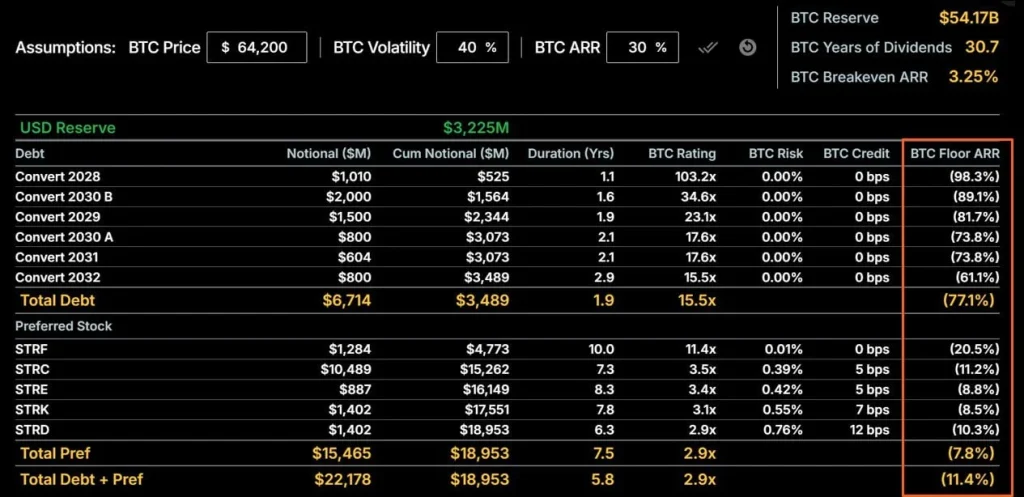
Bitcoin’s Long Decline: A 5.8-Year Forecast from Strategy
There’s a bold claim circulating among cryptocurrency whales. According to Strategy, the dominant capital structure of Bitcoin ($BTC) suggests it could endure an annual decline of 11.4% over an astonishing 5.8 years. This expectation raises questions about both the asset itself and the broader market dynamics.
The Specifics of the Claim
As reported, Strategy asserts that Bitcoin can decline persistently without jeopardizing its financial commitments, such as servicing interest and dividends tied to preferred shares, while maintaining its valuation at 1.0 times BTC. In stark numbers, this implies that $BTC could fall to around $6,950 within that timeframe under these conditions, compared to its current levels hovering around the $16,000 mark.
Why does this matter? The volatility surrounding Bitcoin’s price has been a defining characteristic since its inception. This prediction, if true, suggests a stabilizing effect for those deeply invested in the crypto space, particularly institutions that utilize Bitcoin as part of their capital strategy. However, if the price trajectory heads downward as proposed, it sends alarm bells to retail investors and broader market participants.
Rethinking Capital Structures
The current capital structure referenced by Strategy includes a significant concentration of Bitcoin holdings among a small number of wallets, commonly referred to as “whales.” For context, approximately 42% of Bitcoin is held by the top 100 addresses. Those whales have the influence to keep the crypto market somewhat stable despite adverse conditions. Known for accumulating during dips, these players balance the volatile nature of Bitcoin.
Additionally, a decline of 11.4% annually for nearly six years allows for a continued operation of these firms, assuming their models include effectively managing their cash flows. In other words, institutional players might be prepared to ride out these bearish phases, which could further complicate trading strategies for retail investors who lack similar capital reserves.
Current Market Climate: Merits and Pitfalls
The backdrop here includes a crypto market that remains under pressure, largely due to regulatory scrutiny and macroeconomic factors. For comparisons, if we examine previous cycles, Bitcoin faced a nearly 75% drop in 2018 from its all-time highs, demonstrating that maintaining a bull market isn’t guaranteed, even for the largest cryptocurrencies. Traders must now assess whether a prolonged downturn is a cycle or a structural shift.
Furthermore, the market’s response to various macroeconomic indicators, such as inflation rates and Federal Reserve interest rate moves, could shift this narrative considerably. The crypto sector isn’t decoupled from these traditional financial metrics, meaning many traders need to understand these influences carefully. Strategy’s predictions may hinge on factors outside the cryptocurrency bubble.
The Impact on Retail Investors
This scenario also carries implications for the thousands of retail investors heavily invested in Bitcoin. The average retail investor, often driven by emotions and market trends, may lack the strategies to weather a downturn of this magnitude. If this forecast unfolds, there may be significant panic selling, which could further exacerbate the downward pressure on prices.
Data from various surveys indicate that retail participation in Bitcoin peaked during the bull run of 2020. Today, as many take losses, the question remains: how many can hold through such a protracted downturn? Simply put, liquidity may dry up if retail investors exit en masse, creating a vacuum that larger players might exploit.
Long-Term Implications of Protracted Declines
Should this downturn unfold as predicted, a structural shift toward institutional ownership could occur. The imbalance might increase significantly between those capable of holding under pressure and those trading on sentiment. If only institutions are left, one has to question the sustainability of Bitcoin’s price over the long run.
On the flip side, if we evaluate past performance, Bitcoin has shown periods of resilience following severe corrections. However, understanding that these recoveries typically coincide with bullish phases in the broader economic climate could be pivotal. Meaningful rebounds require conditions favorable for risk-taking—something scarce when macro-adjustment sentiment prevails.
Concluding Observations on Market Sentiment
The notion that Bitcoin could see a steady decline over the next 5.8 years speaks volumes about current market sentiment. The major investors adopting a wait-and-see approach could stabilize Bitcoin’s ecosystem. But will patience wearing thin lead to significant price pressure? One glaring observation: right now, uncertainty seems greater than before.
Looking ahead, steady declines pose the risk of alienating all but the most resilient investors. For traders and institutions, the calculations are intricate; it’s not just about price per se but about managing risk during sustained periods of adverse market conditions. Even while we assess numbers, proactive engagement with market sentiments will remain paramount. Strategy’s thesis may very well serve as a critical juncture for Bitcoin, making this a time to carefully monitor market dynamics, as discussed in our Bitcoin’s Declining Volatility analysis.
Author: Brian J. Ried