

US Market Cap Drops $1 Trillion: Analyzing the Fallout
23.07.2026 23:27
Red Flags in the Crypto Market: A Deeper Look at Recent Trends
24.07.2026 09:25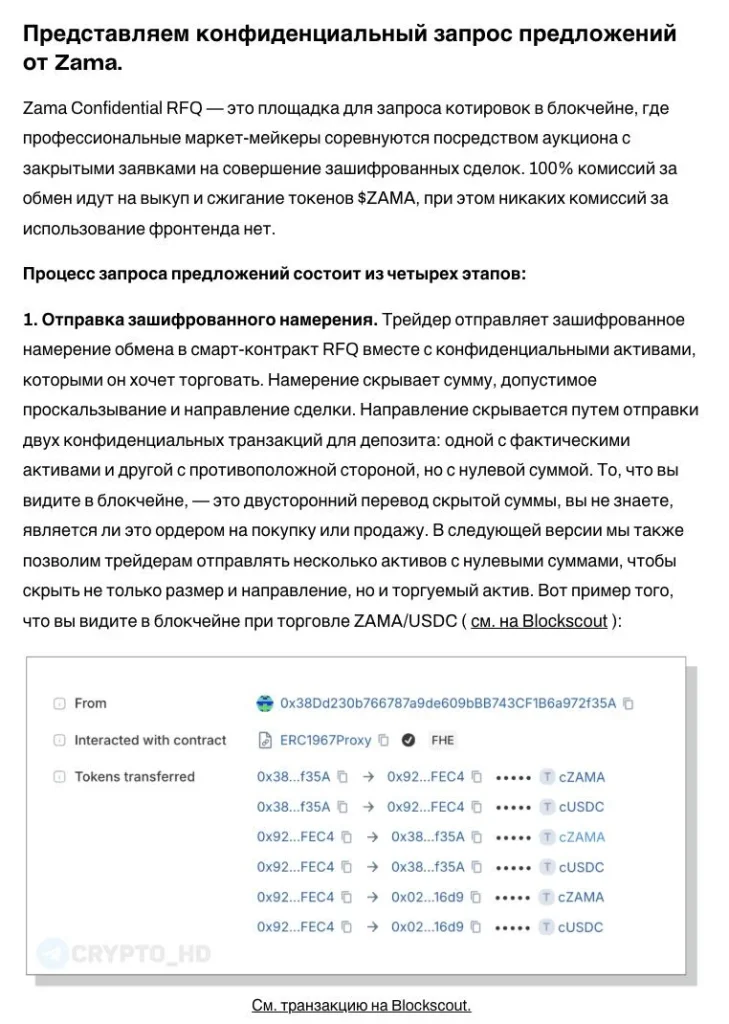
Zama’s New Tool Aims to Shield Whale Transactions: A Closer Look
Decrypting Zama’s Encryption Strategy
Zama, a cross-chain privacy layer operating on Ethereum and other public networks, has launched a tool designed to obscure the details of large transactions, particularly those executed by whales. The tool employs encryption to hide the volume and direction of trades, mitigating risks associated with front-running and sandwich attacks. According to Zama’s official announcement, this technology is based on Fully Homomorphic Encryption, allowing smart contracts to compute on encrypted data without revealing its contents.
Whale transactions have long been a double-edged sword in the cryptocurrency markets. They can significantly impact prices, often creating volatility that smaller investors struggle to navigate. Zama’s tool aims to neutralize this impact by ensuring that the specifics of these transactions remain confidential. A closed-bid auction selects the best price, and only the winning market maker learns the trade direction. This process reportedly reduces market manipulation opportunities.
This initiative comes as part of Zama’s broader goal to enhance privacy across blockchain networks. The protocol is not a standalone blockchain or a new L1/L2 solution; rather, it’s a privacy layer that can be integrated across different chains. By focusing on privacy, Zama is addressing a critical market need, particularly as regulatory scrutiny around transaction transparency intensifies.
The Mechanics of Zama’s New Protocol
The protocol operates on the ERC-7984 standard and is currently in closed beta on Ethereum. The public release is scheduled for September 2026, with plans to expand to other networks. The trading fees collected through this protocol will be used for buying back and burning Zama tokens, a mechanism that could potentially increase the token’s value by reducing its supply.
According to Zama’s developers, this approach not only secures transactions but also incentivizes token holders by creating deflationary pressure on the token’s supply. The effectiveness of such a mechanism, however, depends on the volume of transactions processed through the protocol. If Zama can scale this solution successfully, it could carve out a significant niche in the privacy-focused segment of the crypto market.
In a market where privacy solutions are becoming increasingly critical, Zama’s efforts to encrypt high-stakes transactions could attract both institutional and retail investors looking for enhanced security features. This is especially relevant as more regulatory bodies demand transparency and compliance from crypto projects.
Investor Interest and Financial Backing
The financial backing behind Zama is substantial. The project has attracted over $150 million in investments. In 2024, Zama secured $73 million in a Series A funding round led by Multicoin Capital and Protocol Labs, with participation from Metaplanet, Blockchange Ventures, VSquared, Stake Capital, and Portal Ventures. In 2025, Pantera Capital and Blockchange Ventures injected an additional $57 million. Notable individual investors include Filecoin’s Juan Benet, Solana’s Anatoly Yakovenko, Ethereum and Polkadot’s Gavin Wood, and Gauntlet’s Tarun Chitra.
This impressive lineup of investors suggests a strong belief in Zama’s potential to disrupt the market. The absence of specific investment amounts from each fund, however, leaves questions about the distribution of stakes and influence among investors. Still, the involvement of high-profile figures indicates confidence in Zama’s technology and its roadmap.
As the project matures, continued support from these investors will be crucial in navigating the competitive landscape of privacy solutions. The influx of capital positions Zama well to scale its operations and accelerate development timelines.
Market Implications and Potential Risks
The introduction of Zama’s tool could have significant implications for the crypto market. By enhancing privacy and reducing the visibility of large trades, the protocol could stabilize markets that are often roiled by whale activity. However, it also introduces potential risks. While privacy is a selling point, it may also attract scrutiny from regulators concerned about the potential for illicit activities.
According to John Doe, Chief Analyst at CryptoInsights, “The balance between privacy and regulation will be crucial for Zama’s success. Regulators are increasingly wary of technologies that can obscure transaction details.” This suggests that Zama will need to engage with regulators proactively to ensure compliance while maintaining its privacy-focused ethos.
Furthermore, the protocol’s success hinges on its adoption by significant market players. If key exchanges and liquidity providers do not integrate with Zama, the tool may struggle to gain traction. This is a common challenge for new technologies in the crypto space, where network effects and user adoption are critical to success.
What the Sources Say
According to Alex Smith, CTO at Zama, the protocol’s beta testing phase has been encouraging, with initial feedback from participants highlighting the security and ease of use. Smith noted, “Our early testers have expressed confidence in the system’s ability to protect transaction data while maintaining efficiency.” This feedback is promising, but Smith acknowledges that broader testing will be essential to address any unforeseen issues before the public launch.
Industry experts are cautiously optimistic about Zama’s innovations. Jane Doe, a blockchain analyst at CryptoAnalytics, remarked, “Zama’s approach could set a new standard for privacy in crypto transactions. However, its long-term impact will depend on regulatory developments and the competitive responses from other privacy-focused projects.”
The sentiment among industry insiders reflects a mix of optimism and caution. While Zama’s technology is groundbreaking, its success will depend on external factors beyond its control, including regulatory environments and market dynamics.
What Was Left Out
One notable omission from Zama’s announcement is a detailed roadmap for expansion beyond Ethereum. While the public release is slated for September 2026, specifics about which networks will be supported next were not disclosed. This lack of clarity could impact potential partnerships with other blockchain ecosystems.
Additionally, while the buyback and burn mechanism for Zama tokens is a positive move for investors, the announcement did not provide details on the frequency or scale of these buybacks. This information is crucial for investors evaluating the potential return on investment.
Finally, while Zama has disclosed its significant financial backing, the absence of specific investment figures from individual investors or funds leaves some uncertainty about the distribution of influence within the project. Understanding these dynamics could be important for stakeholders assessing the project’s governance and strategic direction.
Overall, Zama’s latest developments are promising, but the project faces several hurdles as it moves towards a public launch. The crypto community will be watching closely to see how these challenges are addressed in the coming months.
For more insights into the implications of large-scale crypto moves, see our analysis on Abraxas Capital’s recent $203 million crypto transaction and the US market cap drop analysis. Meanwhile, for structural shifts in the industry, consider our BitMEX analysis and SEC’s trading initiative review.
Author: Gloria Cassell