

The Structural Disparity: Local Exploits vs. Global Scale in Digital Finance
23.08.2026 15:54
The Situational Fund’s $20 Billion Bet: Why Public Filings Miss the Structural Mandate of Global Finance in 2026
23.08.2026 17:56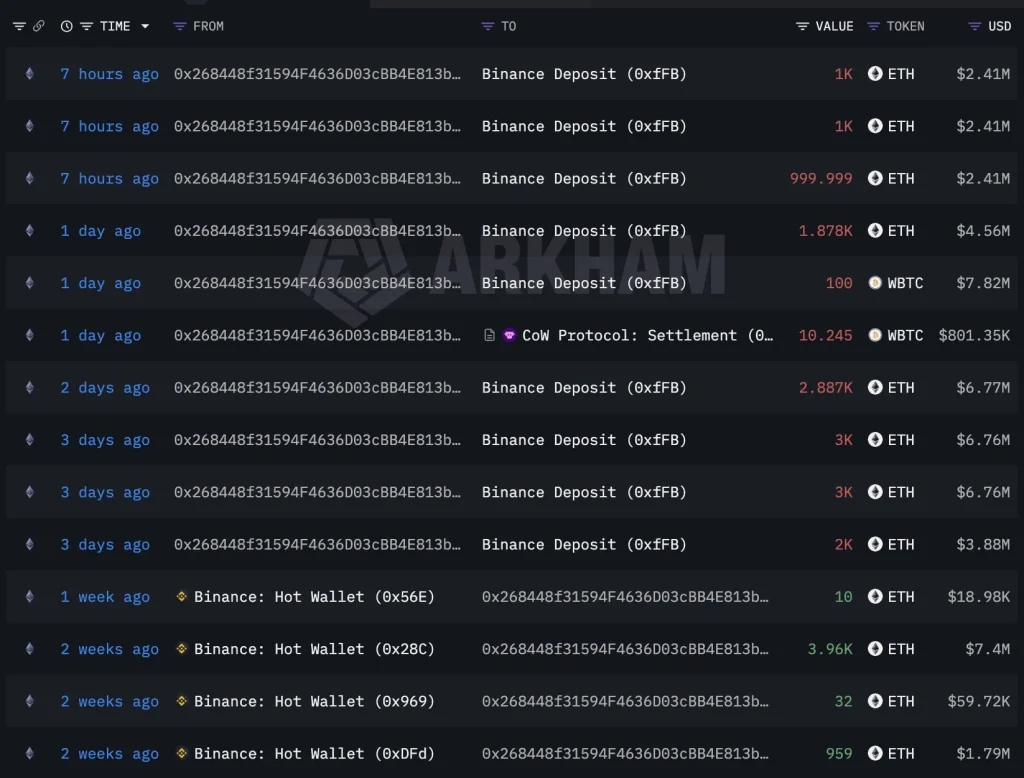
The Structural Disconnect: Why Whale Profit Taking Is Not a Market Signal
The recent activity from a major crypto wallet address—specifically, the accumulation of 79,216 ETH and 1,400 WBTC over several days—is often framed by retail commentary as a bullish signal. The data shows that this single entity sold approximately $36 million worth of ETH at $2,281 per coin and $8.6 million in WBTC at $78,235 per coin, realizing a reported profit of $9.5 million over three days. While these figures are mathematically precise, interpreting them as a definitive indicator of future market direction requires significant caution.
The core issue for any financial journalist is distinguishing between operational activity and structural mandate. This wallet’s actions—buying large amounts at specific price points and then selling to realize profit—are textbook examples of capital management. They quantify the immediate, short-term trading cycle. However, comparing this pattern to traditional finance reveals a fundamental difference in motive. When institutional players manage multi-billion dollar portfolios, their decisions are rarely based on day-to-day price fluctuations; they are driven by macro factors: global debt levels, geopolitical risk, and the exponential compute demands of artificial intelligence.
The market’s focus on this $9.5 million profit takes the eye off the much larger picture. As recently as early 2026, when many commentators focused solely on Bitcoin’s daily price flashes, they missed the structural shift occurring beneath the surface. The current trading window is a micro-event; the underlying systemic pressure is what matters to long-term capital allocation. This wallet’s activity merely confirms that large players are actively managing risk within the existing market structure, not that the structure itself is changing.
The Global Debt and AI Compute Mandate: A Macro View
To understand the true significance of capital flows, one must look beyond the crypto charts and examine global macro indicators. The sheer scale of outstanding sovereign debt—which reportedly exceeds $300 trillion globally—creates a structural imperative for alternative, efficient settlement rails. Traditional banking systems, built on decades-old correspondent banking networks, were not designed to handle this level of systemic liquidity stress combined with modern computational demands.
This pressure is compounded by the AI revolution. The demand for specialized computing power, exemplified by Nvidia’s recent 15% price hike for high-end AI servers, is creating a massive industrial bottleneck. This compute capacity must be paid for, and that payment requires instantaneous, borderless value transfer. If settlement takes days via SWIFT or correspondent banks, the entire global AI supply chain grinds to a halt. The speed of computation now dictates the required speed of money.
This structural necessity is what validates digital assets as essential utility infrastructure. It moves the conversation away from speculation and toward mandatory systemic upgrade. For instance, when Michael Bloomberg, founder of Bloomberg L.P., spoke about the need for real-time data integration across global markets, he was describing a requirement that only distributed ledger technology can reliably meet. The challenge is not technological; it is one of institutional adoption driven by economic necessity.
Comparing Digital Rails to Traditional Finance Plumbing
Consider the analogy of infrastructure. Before the automobile, roads were built for horses and carriages—they were robust enough for their time. The advent of the car required a complete overhaul: paved highways, gas stations, standardized signaling. Today’s global finance is facing an equivalent upheaval. The ‘car’ is AI; the ‘highway’ must be digital settlement rails.
Traditional financial plumbing relies on layers of intermediaries—clearing houses, correspondent banks, and regulatory checkpoints. Each layer adds friction, cost, and time. While these systems have proven resilient over centuries, their inherent slowness becomes a critical vulnerability when dealing with the speed of modern capital deployment. The ability to settle billions in seconds across multiple jurisdictions is not merely an efficiency gain; it is a prerequisite for global economic stability in 2026.
The comparison holds true even when looking at asset classes like gold or equities. While gold remains a store of value, its physical transfer and settlement are inherently slow and limited by geography. Equities markets, while advanced, still operate within the constraints of national regulatory frameworks that limit cross-border speed. Digital rails offer a path to global fungibility and instant finality—a capability traditional systems struggle to match without massive, costly overhauls.
The Significance of Capital Flow Patterns Over Price Action
When analyzing capital flows, the *direction* and *volume* are far more telling than the price chart itself. The recent large movements by firms like Wintermute into SOL and ETH on Binance quantify this structural shift. These aren’t retail trades; they represent institutional positioning for a paradigm change in settlement utility. They are betting on the necessity of decentralized rails.
This contrasts sharply with short-term price action, which is often driven by sentiment or temporary liquidity injections. The daily fluctuations seen in Bitcoin—for example, the recent $77,566.57 USDT price point reported on MEXC—are easily dismissed as noise when viewed against the backdrop of global debt servicing and AI compute demand. Price volatility is a symptom; structural necessity is the cause.
Furthermore, examining the failure points in decentralized finance (DeFi) provides critical counter-evidence to market hype. The governance vulnerability exposed by the Term Finance attack highlights that even highly sophisticated protocols face systemic risks far beyond simple coding bugs. These failures are not proof of concept for decentralization; they are simply operational challenges within a nascent infrastructure, much like early railroads faced engineering hurdles.
What Was Left Out: The Regulatory and Utility Angle
The market narrative often focuses on the ‘how’—the technology. What is less discussed, but critically important, is the ‘why.’ The regulatory bodies are not merely reacting to crypto; they are attempting to *incorporate* its utility into global finance because of the structural pressures we detailed. This shift from viewing digital assets as a niche speculative market to recognizing them as mandatory financial plumbing is the most significant development.
The move by major stablecoin issuers, such as Circle, to integrate their tokens with Real-World Assets (RWAs) confirms this institutional acceptance of utility. Stablecoins are no longer just crypto hype; they are becoming essential working capital for cross-border trade and tokenized assets. This is the point where digital rails transition from a speculative tool into an indispensable piece of global economic machinery.
[Editorial Verdict] The current market focus on isolated exploits or short-term price support zones fundamentally misunderstands the macro forces at play. Capital flows and systemic utility are the only metrics that matter when assessing the long-term viability of digital assets in a world defined by AI compute demand and massive sovereign debt.
Author: Gloria Cassell, Crypto News Editor






3 Comments
Hello http://aicoinbooster.com,
I hope you’re doing well. I came across your business online and thought you might be interested in improving your visibility and traffic on search engines.
We specialize in helping businesses strengthen their online presence through effective SEO strategies.
Once you share your target keywords and target market, I’ll send a full proposal.
Warm regards,
Asif
Hi,
I came across aicoinbooster.com and wanted to reach out.
We help brands and businesses quickly tell their story through short promotional videos for websites and social media.
We keep things pretty lean — projects start from one hundred and ninety-five dollars USD, which includes the script, voice-over, and full production.
Happy to send over a couple of samples if you’re open to taking a look.
Best,
Jo Riggs
Dear http://aicoinbooster.com/fekal0911 Administrator