

Chinese Stock Market Sees Dramatic Decline: Implications for Global Markets
17.07.2026 15:09
BitShine Exchange Organizer Sentenced to 22 Years for $39 Million Fraud in Taiwan
17.07.2026 15:35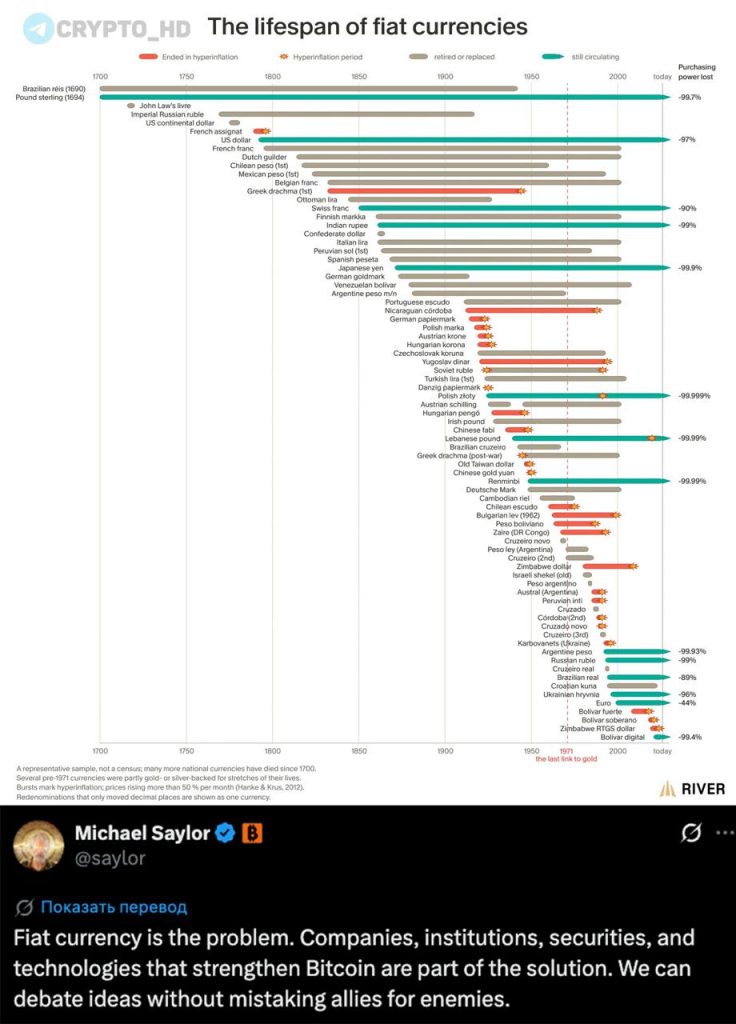
The Life Expectancy of Fiat Currencies: A Historical and Market Analysis
Background and Context
The average lifespan of fiat currencies stands at a mere 27 years, a statistic that underscores the inherent instability of government-issued money. This phenomenon has been documented since the 1700s, with various fiat currencies disappearing due to hyperinflation, replacement by more stable currencies, or simply losing up to 99% of their purchasing power over time. The significant decline in fiat currency value raises critical questions about the long-term viability of these monetary systems, especially as digital assets like Bitcoin gain popularity.
Historically, fiat currencies have faced myriad challenges. The Roman denarius, for instance, saw its silver content decline drastically over centuries, leading to inflation that ultimately precipitated its demise. More recently, the hyperinflation in Zimbabwe during the late 2000s resulted in the abandonment of the Zimbabwean dollar altogether, illustrating the potential for rapid devaluation. In contrast, Bitcoin, designed as a deflationary asset with a capped supply, stands in stark contrast to these historical examples of fiat failure.
Key Data and Metrics
Michael Saylor, a prominent figure in the cryptocurrency community, argues that fiat systems are fundamentally flawed. He references a graph from River Financial that highlights the diminishing lifespans of fiat currencies and their tendency to collapse under economic stress. According to Saylor, the evidence is clear: fiat is doomed as a monetary system. The metrics support this assertion, as research indicates that several fiat currencies have lost between 90-99.9% of their value over their lifespans.
For instance, the Argentine peso has faced severe devaluation, losing over 90% of its value against the US dollar in the past two decades. Similarly, Venezuela’s bolívar has experienced extreme hyperinflation, rendering it virtually worthless. These examples serve to illustrate the fragility of fiat currencies and the potential advantage of transitioning to more stable digital assets like Bitcoin.
Market Analysis
The implications of fiat currency instability extend into the cryptocurrency market, where the demand for Bitcoin and other digital assets has surged. As investors seek refuge from the declining purchasing power of fiat money, Bitcoin’s ascendance signifies a shift in how value is perceived and stored. The correlation between fiat devaluation and Bitcoin’s price movements is increasingly evident, with Bitcoin often rallying during periods of economic uncertainty.
Moreover, the financial flows into cryptocurrency ETFs reflect this trend. According to our recent analysis on crypto ETF financial flows, there has been a noticeable uptick in institutional investment in Bitcoin, suggesting that larger players are also hedging against fiat currency volatility. The market capitalization of Bitcoin has surpassed $700 billion, further solidifying its position as a viable alternative to traditional fiat currencies.
Expert Perspectives
Experts in the field, including economists and financial analysts, highlight the strategic importance of cryptocurrencies like Bitcoin in a world where fiat currencies are increasingly under threat. The narrative among proponents of Bitcoin is that it represents not just a store of value, but also a hedge against systemic failures within fiat systems.
As discussed in our piece on XRP’s potential surge, cryptocurrencies are being viewed as pivotal to the future of finance, offering decentralized solutions that are less susceptible to government interference and inflationary pressures. These expert insights further reinforce the idea that Bitcoin and similar assets could be integral to a more stable financial future.
Risks and Opportunities
While the opportunities presented by the shift from fiat to cryptocurrency are significant, there are also inherent risks. Regulatory scrutiny is one such risk, as governments worldwide grapple with how to manage and regulate digital currencies. The recent MiCA license secured by BitPay reflects a move towards regulation, which could either stabilize the market or stifle innovation, depending on how policies are implemented.
Additionally, the volatility of cryptocurrencies remains a concern for investors. Unlike fiat currencies, which can sometimes provide a degree of stability, Bitcoin and its counterparts can experience extreme price fluctuations. This volatility can deter conservative investors, although it also presents opportunities for those willing to engage in high-risk trading.
Future Outlook
Looking ahead, the trajectory of fiat currencies seems increasingly uncertain. As the average lifespan of these currencies continues to shrink, the potential for Bitcoin and other cryptocurrencies to redefine the financial landscape becomes more tangible. The ongoing discussions around institutional adoption and regulatory frameworks will shape how this transition unfolds.
The recent surge in interest surrounding cryptocurrencies, highlighted by the significant trading volumes reported in our article on HTX trading volume, indicates a growing acceptance of digital currencies as viable alternatives to fiat. This trend, coupled with the increasing disillusionment with traditional monetary systems, suggests a paradigm shift is imminent.
Conclusion
In conclusion, the average lifespan of fiat currencies, now pegged at 27 years, serves as a stark reminder of their vulnerabilities. As Bitcoin and other cryptocurrencies rise to prominence, they offer a potential solution to the systemic issues associated with fiat. Investors and traders must stay informed about these developments, as the future of finance may very well depend on the adoption of decentralized digital assets. As discussed in our analysis of the Chinese stock market, understanding these dynamics is crucial for navigating the evolving financial landscape.