
The Danger of Paid Crypto Trading Signals: A Guide to Risk Management | MEXC Analysis
06.07.2026 21:15BonkDAO Governance Attack Analysis: What Happened and What Does It Mean for Web3?
06.07.2026 21:49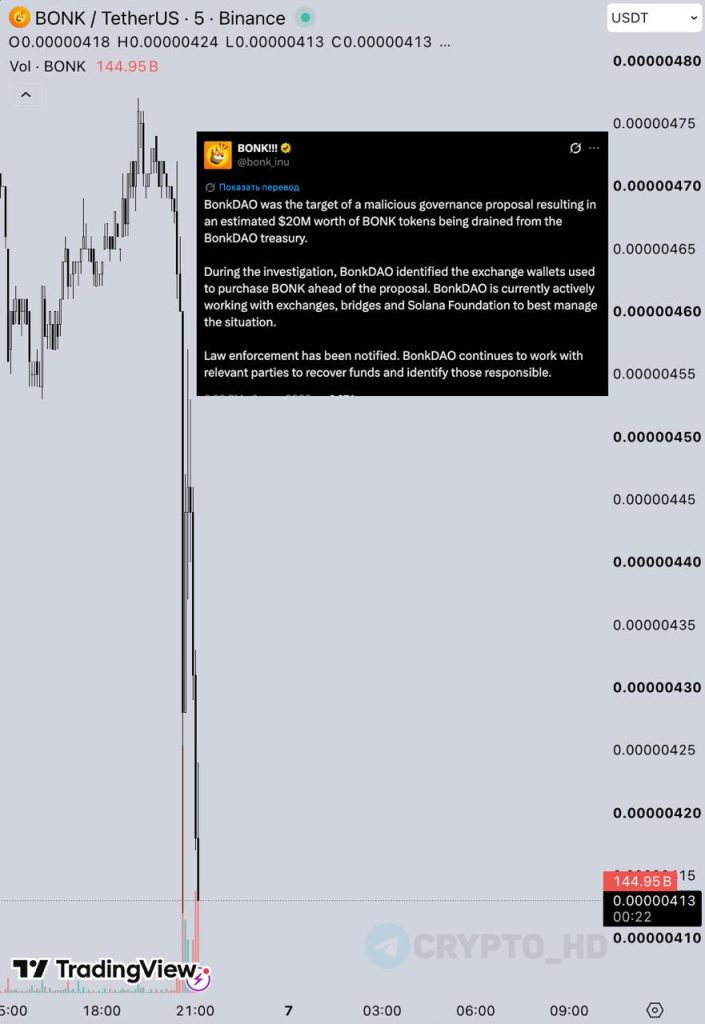
The $20 Million BonkDAO Hack: What It Means for Decentralized Finance (DeFi) Security
The recent hack of BonkDAO, resulting in the loss of an estimated $20 million through a malicious governance proposal, serves as a stark and critical wake-up call to the entire decentralized finance (DeFi) ecosystem. This incident is not just about lost funds; it exposes fundamental vulnerabilities in how Decentralized Autonomous Organizations (DAOs) manage treasury assets and vote on proposals.
Understanding the Attack Vector: Malicious Governance
The core vulnerability exploited was the governance mechanism itself. In a DAO, decisions are made by token holders voting on proposals. Hackers successfully passed a malicious proposal that allowed them to drain funds from the DAO’s treasury. This highlights a critical gap: while DAOs provide unprecedented autonomy, they can also be manipulated if security protocols and due diligence are lacking.
The immediate response from the BonkDAO team—identifying the wallets and collaborating with exchanges and the Solana Foundation—shows resilience, but it underscores that recovery is always an uphill battle. The incident serves as a powerful reminder that **governance proposals must be scrutinized by experts**, not just passed by token holders.
Key Takeaways for DeFi Security
- Due Diligence is Paramount: Every governance proposal, especially those involving large sums of money or treasury funds, must undergo rigorous security audits.
- Multi-Signature Wallets (Multisig): Relying on a single point of failure or an easily manipulated voting system is dangerous. Implementing multisig requirements adds necessary layers of human oversight and consensus.
- Time Locks: Introducing mandatory time delays after a proposal passes gives the community, security experts, and auditors time to react and identify malicious intent before funds are moved.
The Broader DeFi Landscape
This BonkDAO hack is part of a larger trend in Web3 where innovation outpaces regulation and security best practices. While DAOs offer incredible potential for community-driven finance, the risks associated with smart contract exploits and governance manipulation are real.
How This Relates to Institutional Adoption
The contrast between these volatile, hackable DeFi protocols and the steady accumulation patterns of institutional players is striking. Major financial entities like BlackRock continue their massive BTC & ETH Accumulation Signals Institutional Conviction, showing a preference for established, regulated assets over high-risk, unvetted DAO treasuries.
Furthermore, the underlying asset class—Bitcoin—remains remarkably resilient. Despite market volatility and hacks in peripheral DeFi sectors, Bitcoin’s core value proposition as a decentralized store of value continues to attract massive capital inflows, as seen when analyzing the BTC Rebound: Analyzing the $63K Bounce After Macro Signals and Institutional Interest.
Navigating Crypto Risk with MEXC
The crypto market is a high-risk, high-reward environment. While hacks like BonkDAO’s are alarming, they also serve as educational moments that reinforce the need for disciplined risk management. Never invest what you cannot afford to lose.
To navigate this complex landscape safely and capitalize on both institutional trends and emerging opportunities, a reliable exchange is essential. MEXC provides the tools and global access needed to manage your crypto portfolio responsibly. Start trading securely today:
🚀 Trade Securely on MEXC Today!
*Disclaimer:* This article is for educational purposes only and does not constitute financial advice. Always conduct your own research (DYOR) before making investment decisions.
***
**Tags:** Bonk, DAO, DeFi, Security, Hack, Crypto, MEXC
**Category:** Market Analysis